The Difference Comes Down to One Thing: How the Burners Fire
If you're comparing new furnaces, three words come up fast: single-stage, two-stage, and multi-stage (you'll also see it called "modulating"). Simply, a furnace's "stage" is how much heat it can produce at once. That one difference changes how even your temperatures feel, how quiet the system runs, and what shows up on your winter gas bill.
Ready to compare options for your home? Get a real number in minutes with our Instant HVAC Quote tool or call 314-819-0028.
What Is a Single-Stage Furnace?
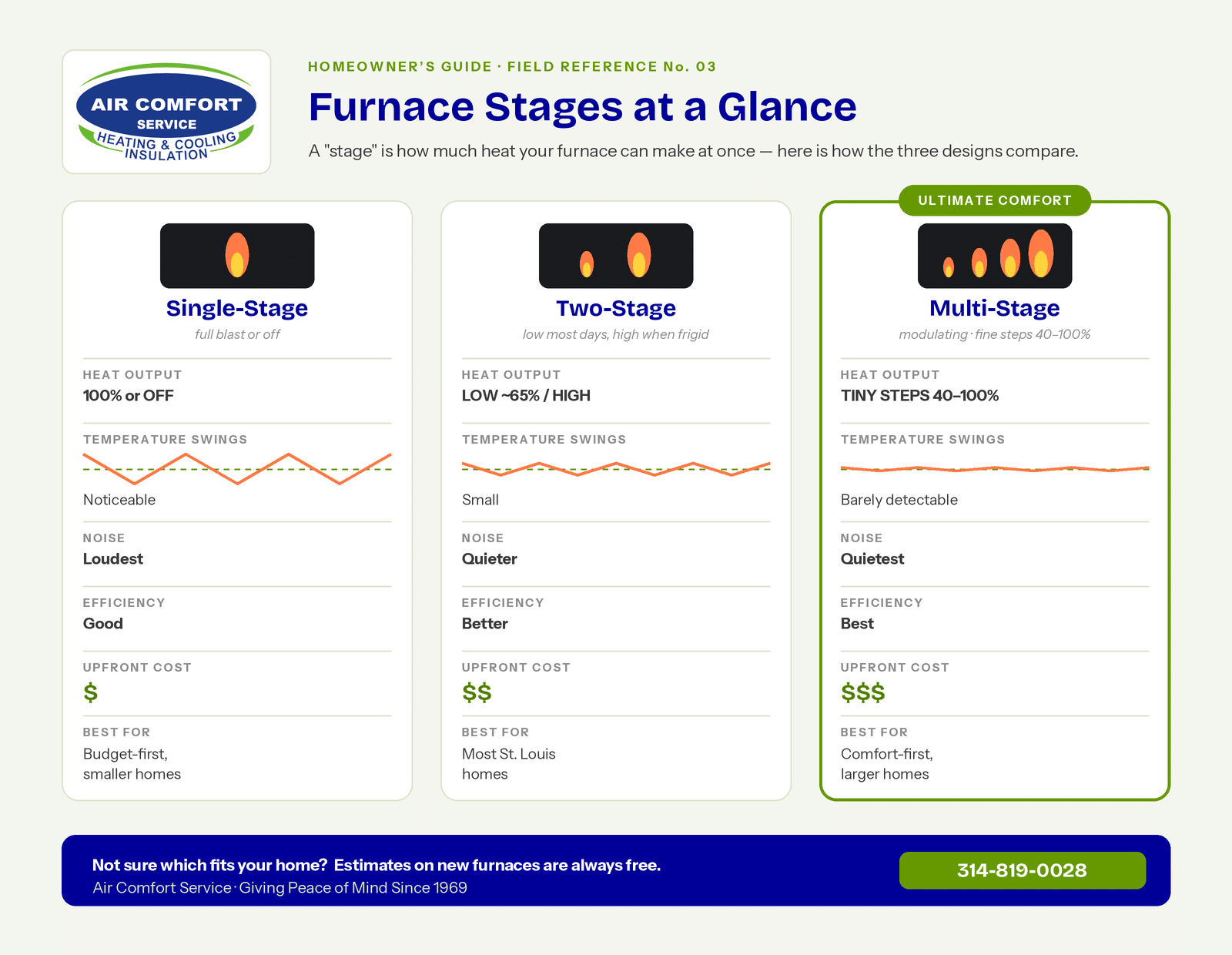
A single-stage furnace has one setting: full blast. Like a light switch, the burners are either 100% on or completely off. When your thermostat calls for heat, the furnace roars to life, heats the house past the set point, and shuts off, then repeats.
What Single-Stage feels like at home:
Bigger temperature swings.
The house overshoots, cools off, and the cycle starts again. Rooms far from the thermostat feel it most.
More noticeable starts and stops.
Every cycle begins at full volume.
Lowest upfront cost.
Fewer components, simplest design, least expensive to buy and install.
A single-stage furnace is a fair choice for smaller homes, rentals, or anywhere upfront budget is the deciding factor. It's simple, proven, and reliable.
What Is a Two-Stage Furnace?
A two-stage furnace adds a low setting, roughly two-thirds power. It runs on low most of the time, and only shifts to high when a cold snap demands it. In a typical St. Louis winter, where most days sit in the 30s and 40s and only a handful drop into the single digits, that low stage handles the vast majority of the heating season.
What Two-Stage feels like at home:
Longer, gentler cycles.
Cycles that hold your temperature much closer to the set point.
Quieter operation.
Low fire means lower blower speed and less noise.
More even temperatures upstairs and down,
Air moves longer and mixes better.
Is a two-stage furnace worth it? For most St. Louis homes replacing a 15-plus-year-old single-stage unit, the comfort difference is what people notice first, and it's the most popular middle ground on price.
What Is a Multi-Stage (Modulating) Furnace?
A multi-stage furnace (the industry also calls it a modulating furnace) fine-tunes itself continuously. Instead of one or two settings, it adjusts its flame in tiny increments, roughly 40% to 100% of capacity, like cruise control for your comfort. It's typically paired with a variable-speed blower that ramps airflow up and down just as smoothly.
What Multi-Stage feels like at home:
Longer, gentler cycles.
The system matches your home's heat loss almost exactly, often holding within a degree of the set point.
The quietest operation available.
Long, low, nearly silent run times.
The highest efficiency.
Modulating furnaces top the AFUE charts, wringing the most heat out of every therm of gas, which matters over a St. Louis heating season that runs from October into April.
If you've ever been annoyed that one bedroom is always cold or that the furnace wakes you up at night, this is the tier that fixes it.
Side by Side: Which Furnace Fits Your Home?
There's no single "right" answer; it's a trade-off between upfront cost and long-term comfort and efficiency. The right pick depends on your home's size, layout, insulation, and how long you plan to stay.
Not sure which stage fits your budget? Run the Instant HVAC Quote tool, it takes about a minute.
Two Things St. Louis Homeowners Should Check Before Deciding
Your thermostat.
Two-stage and multi-stage furnaces perform best with a thermostat that can control staging. Many smart thermostats handle this well. If you're pairing one with a new furnace, we'll set it up as part of the install. (New to smart thermostats? Start with our smart thermostat guides for ecobee by Carrer® and Carrier® Infinity.
Your ductwork and insulation.
A multi-stage furnace can't fix comfort problems caused by leaky ducts or a thin attic. If your home struggles to hold heat, attic insulation is often the better first dollar spent, and it makes whichever furnace you choose cheaper to run.
What a New Furnace Costs and How to Get a Real Number
Furnace pricing depends on staging, size, efficiency rating, and your home's ductwork, so any price you see online is a guess. Estimates on new furnace installations from Air Comfort Service are always free: a technician measures your home, checks your ducts, and quotes real numbers for a good-better-best set of options — typically a single-stage, two-stage, and multi-stage path, so you can see the actual price gaps instead of guessing.
Financing is available, and our furnace installation team handles permits, haul-away, and setup of your thermostat staging.
Wondering whether your current furnace even needs replacing yet? Try the Repair or Replace tool first.
FAQs
A: A single-stage furnace runs at 100% capacity or not at all. A two-stage furnace adds a low setting around two-thirds power that it uses most of the time, shifting to high only on the coldest days. The result is longer, quieter cycles and steadier temperatures.
Talk it Through with Air Comfort Service
Book a FREE home estimate and one of our experienced project managers will help you find the solution that best fits your home and budget.