If you've ever looked into upgrading your attic insulation, you've run into R-value within the first two sentences of any article or estimate. But most explanations stay too vague to be useful. Here's what R-value actually means for a St. Louis homeowner, what your home likely needs, and how to find out whether what you have is doing its job.
What R-Value Means
R-value measures thermal resistance, which is how well a material slows heat from moving through it. Higher number = better performance. In summer it keeps attic heat from creeping into your living space; in winter it keeps the warmth you've paid for from escaping out.
One thing R-value doesn't measure is air sealing. Perfectly rated insulation still allows heat to sneak through gaps around light fixtures or attic hatches. We'll come back to that.
How R-Value Is Measured
R-value is expressed as a number representing resistance per inch of material thickness, then multiplied by total installed thickness. A material rated at R-3.5 per inch installed at 5 inches yields approximately R-17.5.
Different materials achieve different R-values per inch:
| Insulation Type | R-Value per Inch |
|---|---|
| Blown-in fiberglass | R-2.2 to R-2.7 |
| Blown-in cellulose | R-3.2 to R-3.8 |
| Insulation Type | R-Value per Inch |
|---|---|
| Blown-in fiberglass | R-2.2 to R-2.7 |
| Blown-in cellulose | R-3.2 to R-3.8 |
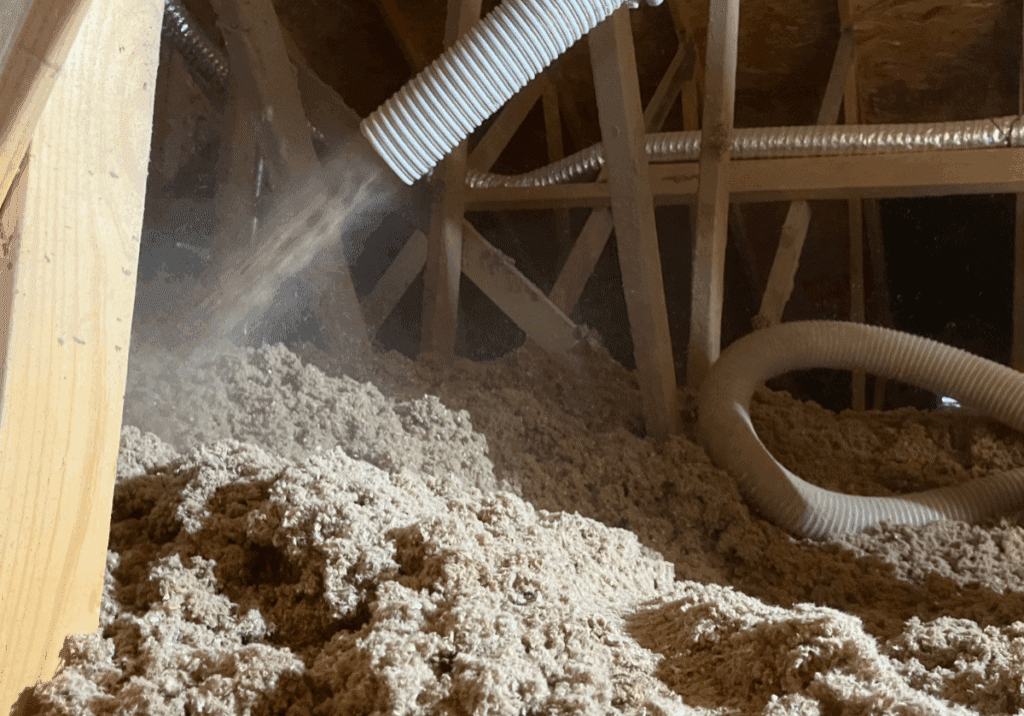
This matters because attic insulation settles over time, and what started as 10 inches of blown-in fiberglass may now measure 7 inches. The R-value your home had at construction isn't necessarily what it has today.
What R-Value Does St. Louis Need?
St. Louis is in IECC Climate Zone 4, which involves hot humid summers and cold winters. The DOE recommends:
- Attic: R-38 to R-60
- Exterior walls: R-13 to R-15 in the cavity, plus R-5 continuous
- Floor over unconditioned space: R-25 to R-30
- Basement walls (if conditioned): R-10 to R-15
The attic is generally the first place to focus. Most St. Louis homes built before 2000 have attic insulation in the R-19 to R-25 range, which is below the DOE's R-38 to R-60 recommendation. If your home hasn't had insulation added and falls in that window, your HVAC is working harder than it needs to.
Where It Matters Most in Your Home
Not every surface has the same impact. In order of priority:
- Attic floor: The highest-priority location in almost every home. Bringing attic R-value from R-19 to R-49 is one of the highest-return improvements.
- Crawl space and basement rim joists: Small in area but highly conductive. Uninsulated rim joists are a common cause of cold floors and drafts in older homes.
- Exterior walls: Blown-in insulation can be added to existing wall cavities without removing drywall.
- Floors over unconditioned spaces: A room over a garage or crawl space loses heat in winter and gains it in summer. Batt insulation between joists helps, but air sealing the perimeter matters most.
Why R-Value Isn't the Whole Picture
Two homes with the same R-value can perform very differently:
Thermal bridging: Wood studs conduct heat at roughly R-1 per inch, creating conductive paths through your walls no matter how good the surrounding insulation is.
Compression: A fiberglass batt crammed into too small a cavity performs well below its rating because the fibers can't trap air properly.
Air gaps: Insulation slows conduction, but it doesn't stop air movement. Gaps around pipes, recessed lights, and HVAC ducts let air carry heat through regardless of the R-value around them. Air sealing before adding insulation is always the right sequence.
Does Your St. Louis Home Have Enough Insulation? Use the R-Value Measurement Tool below to find out. Answer a few questions about your home's age, attic depth, and current insulation type, and get a recommendation specific to St. Louis's Climate Zone 4 requirements. It's free and only takes about two minutes.
Signs Your Insulation Might Be Underperforming
You don't always need to get in the attic to spot the signs:
- Uneven temps floor to floor: second floors stubbornly warmer in summer or colder in winter
- HVAC running long cycles: the system runs and runs without reaching the set temperature
- Energy bills that spike beyond what the weather alone explains
- Ice dams in winter: when escaping attic heat melts snow that refreezes at the eaves
- Rooms that are never quite comfortable no matter what the thermostat is set to
Two or more of these together is a signal that your insulation is underperforming and your HVAC is picking up the slack.
Book a Free Insulation Assessment
Visit our insulation services page to learn more, or call (314) 819-0028 to schedule an evaluation.