
For most St. Louis homes, a MERV 8 to MERV 11 filter is the right choice.
Change a 1-inch filter every 1 to 3 months, and a 4-inch to 5-inch media filter every 6 to 12 months. If anyone in your home has allergies, or you have pets, lean toward MERV 11 and change it more often.
That one filter is the hardest working part of your heating and cooling system, and it costs a few dollars. Here is everything you need to pick the right one, put it in the right way, and know when to swap it.
What does a MERV rating mean on an air filter?
MERV stands for Minimum Efficiency Reporting Value. It is an industry standard scale (ASHRAE 52.2) that runs from 1 to 16 for home filters, and it measures one thing: how well the filter captures particles of different sizes. The higher the MERV number, the smaller the particles the filter can trap.
Low MERV filters mostly protect your equipment from dust and lint. Mid-range filters also protect the people in the house by trapping pollen, pet dander, and mold spores. The highest residential ratings can capture smoke particles and even some bacteria.
One thing the big number does not tell you: a higher MERV filter is also harder to pull air through. That matters, and we will get to it in a moment.
You may also see MPR (used by Filtrete/3M) or FPR (used by Home Depot brands) on the package. Those are store rating systems for the same idea. As a rough guide, MPR 1000 to 1200 and FPR 7 both land near MERV 11.
What MERV Rating Do I Need?
For most St. Louis homes, the honest answer is MERV 8 to MERV 11.
-No pets, no allergies: MERV 8 does the job.
Pets or seasonal allergies: MERV 11. St. Louis is tough on allergy sufferers: oak and other tree pollen load the air in April and May, and ragweed takes over from August into October. A MERV 11 filter captures most of what makes those months miserable indoors.
Asthma, serious allergies, or wildfire smoke days: MERV 13, with one important check first; the higher the MERV rating, the more resistance the filter adds, and your blower has to work against it. Many St. Louis homes are 40 years old or older, and plenty of them run systems that were not designed for a dense 1-inch MERV 13 filter. Put one in the wrong system and you can lose airflow, lose comfort, and stress the equipment you were trying to protect.
If you want MERV 13 performance, have us confirm your blower can handle it, or step up to a 4-inch to 5-inch media cabinet filter, which delivers high MERV ratings with far less airflow restriction. Call (314) 819-0029 and one of our award-winning experts will help you find the right solution.
MERV Rating Chart
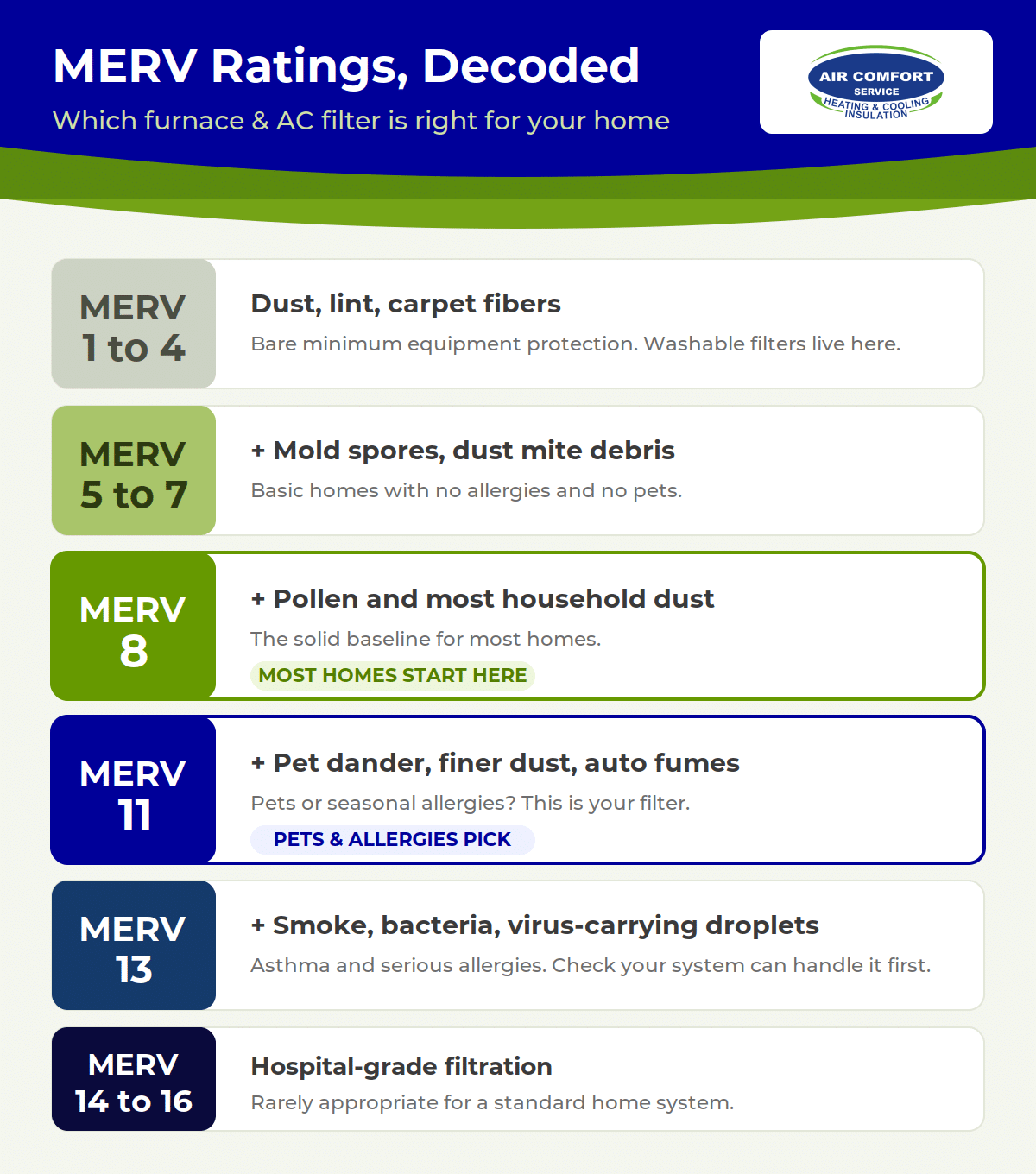
MERV 8 vs MERV 11: which should you buy?
If nobody in the house sneezes and nothing in the house sheds, MERV 8 is enough. If you have a dog, a cat, or a family member who dreads pollen season, spend the extra couple dollars on MERV 11. The airflow difference between 8 and 11 is small enough that nearly any system in decent shape handles it.
MERV 11 vs MERV 13: is the upgrade worth it?
MERV 13 is the first rating that meaningfully captures smoke and the fine droplets that carry bacteria and viruses. For most families, MERV 11 is the sweet spot. Move to 13 when there is asthma or serious allergy in the house, and confirm your system can take it (see above). In a 1-inch slot, a MERV 13 filter also clogs faster, so plan on changing it more often.
Furnace filter sizes: how to find yours
Pull out your current filter and look at the frame. The size is printed right on the edge, usually as width x height x depth, like 16x25x1 or 20x25x4.
Two things trip people up:
Nominal vs actual size. The printed size is rounded. A "16x25x1" filter actually measures about a quarter inch to half an inch smaller each way. Buy by the printed (nominal) size and match it exactly to what came out.
No filter at the furnace? Some homes have the filter behind a return air grille in a wall or ceiling instead of at the equipment. If you find a grille with a hinged door, your filter lives there.
Common sizes: 16x20, 16x25, 20x20, 20x25, and 14x25 in 1-inch depth, plus 16x25x4 and 20x25x5 media filters. If your size is odd or you cannot find it, call us and we will track it down: (314) 819-0029
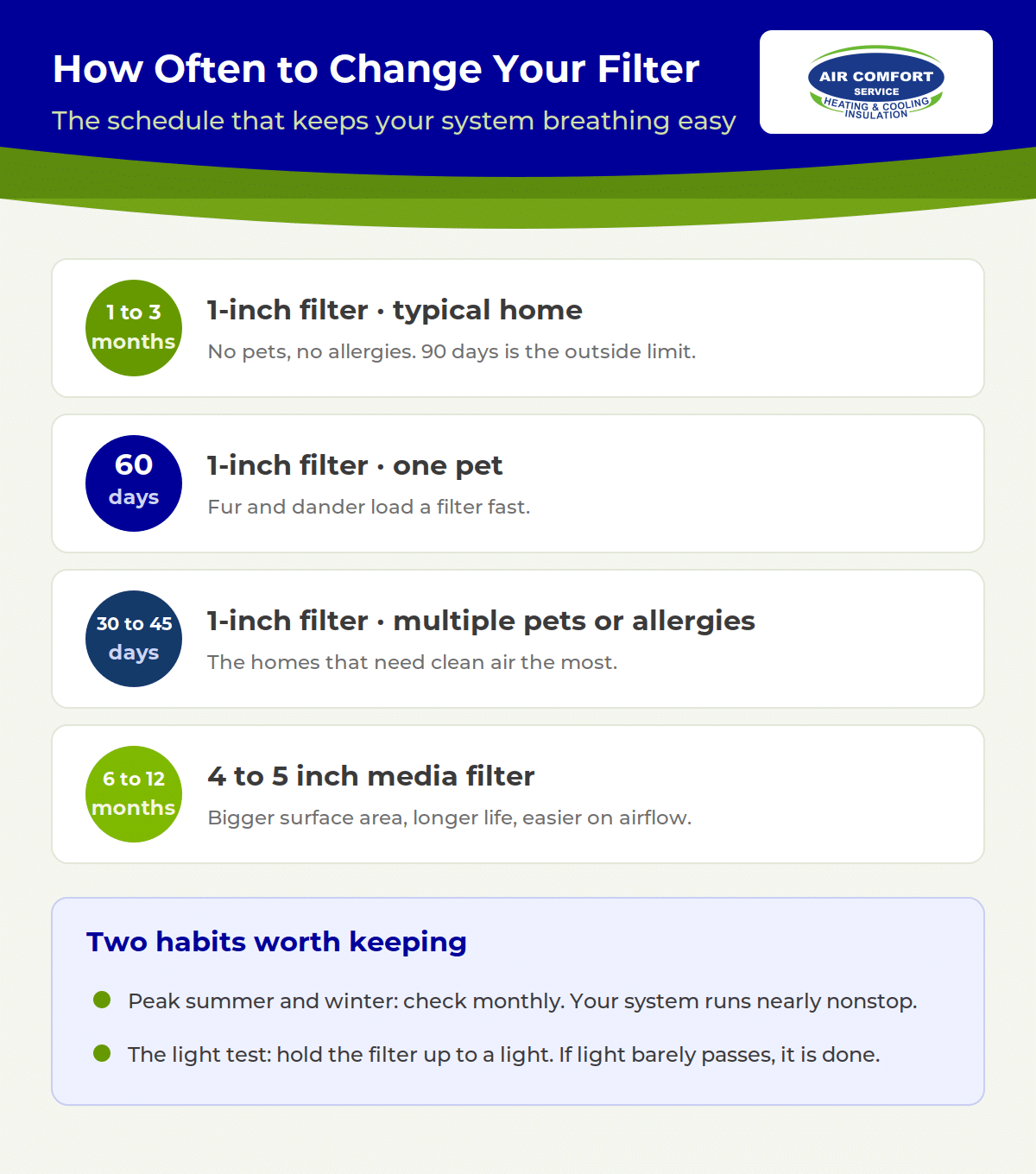
How often should you change your furnace filter?
1-inch filters: every 1 to 3 months. Every 90 days is the outside limit for a typical home. Pets in the home: every 60 days. More than one pet, or anyone with allergies: every 30 to 45 days.
4-inch to 5-inch media filters: every 6 to 12 months.
Peak season: check monthly. In a St. Louis July or January your system runs nearly nonstop, and filters load up fast.
The same schedule applies whether it is heating season or cooling season. The filter serves the furnace and the AC alike, because both push air through the same blower and the same filter slot.
Easy habit: check the filter when your utility bill arrives. Hold it up to a light. If light barely passes through, it is done.
How to change a furnace filter (and which way the arrow goes)
1. Turn the system off at the thermostat.
2. Find the filter slot: at the furnace or air handler, or behind a return grille.
3. Slide the old filter out and note the size printed on the frame.
4. Check the airflow arrow on the new filter. Every filter has an arrow on the frame. The arrow points in the direction the air flows: toward the furnace or air handler, away from the return duct. At a return grille, the arrow points into the wall or ceiling.
5. Slide the new filter in, arrow pointing the right way, and close it up.
6. Turn the system back on. Write the date on the filter frame with a marker. Future you says thanks.
If the filter is in an awkward spot, or you would rather have eyes on the whole system while it is done, filter checks are part of every Air Comfort Service System Check
What happens if you don't change your air filter?
Nothing dramatic on day one. Then, quietly:
Your bills creep up. A clogged filter makes the blower push against a wall. Restricted airflow makes the system run longer to do the same job.
Your AC can freeze. Weak airflow across the cooling coil lets it ice over, and an iced coil cannot cool your house at all.
Your furnace runs hot. Poor airflow makes a furnace overheat and shut itself down repeatedly, which shortens its life.
Your comfort slips. Rooms cool and heat unevenly, and dust settles faster on everything.
We have been fixing St. Louis heating and cooling systems since 1969, and a filter nobody changed is one of the most common root causes our technicians find. It is the easiest problem in this business to prevent.
When a filter is not enough
A good filter handles particles. It does not handle humidity swings, odors, or what grows on a damp cooling coil in a humid St. Louis summer. If someone in your home is still struggling with air quality on a fresh MERV 11 filter, an Air Purifier or UV light is the next step up, and we are glad to walk you through the options.
And if remembering filters is the part that fails, we have a solution for that. The Preferred Partner Plan starts at $19 per month and includes two system checks per year, where a technician inspects your filter setup along with the rest of the system, plus priority scheduling and repair discounts. Giving Peace of Mind Since 1969.
Questions about your filter or your system? Call the family that has kept St. Louis comfortable since 1969: (314) 819-0029.
FAQs
A: Most St. Louis homes do best with MERV 8 to MERV 11. Choose MERV 8 if you have no pets and no allergies, MERV 11 if you have either, and MERV 13 only if allergies or asthma are serious and your system can handle the added airflow resistance. When in doubt, ask us to check your blower's capability.