
If your home was built 15 years ago. the insulation in your attic today isn't the same insulation as when you built. It's thinner, more compressed, and doing a lot less work, and your energy bills have probably been making up the difference ever since.
Here's what's happening and how to check it yourself.
Why Blown-In Insulation Settles
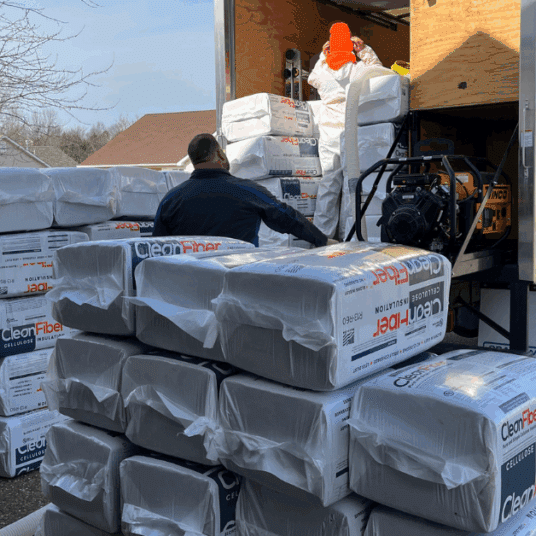
Blown-in insulation is loose fill. It lofts to a certain depth at installation and compresses over time from gravity, humidity cycles, and the general vibration of a house. Same material, less depth, lower R-value. A 12-inch layer of blown-in fiberglass installed at R-30 can compact to 8 or 9 inches over a decade, dropping to roughly R-20 to R-22.
Not all types settle the same way:
Blown-in fiberglass
Settles the most, typically 15–25% depth reduction over 10–15 years. St. Louis humidity accelerates it.
Blown-in cellulose
Settles somewhat less, but moisture exposure speeds it up and can cause clumping.
The R-Value Gap in Most St. Louis Homes
Most St. Louis homes were built between 1950 and 1990, when insulation standards were much lower. A home built in 1975 might've started at R-11 to R-19, already below today's DOE recommendation of R-38 to R-60 for Climate Zone 4. After decades of settling, that same attic could be down to R-8 to R-14.
Most homes we assess come in between R-19 and R-25. That gap means your HVAC is compensating for heat loss in winter and heat gain in summer every single day. On a July afternoon, an under-insulated attic can hit 140-150°F and that heat radiates straight down into your living space.
Use the R-Value Settling Tool. Simply enter your home's age, insulation type, and estimated current depth, and get a calculated R-value estimate along with a recommendation for how much to add to hit the Zone 4 target. It's free and takes about two minutes.
Do You Have to Remove the Old Insulation First?
Usually, no as long as the existing insulation is dry and pest-free. Keep in mind, if your home was built before 1980, you may have vermiculite, which can contain asbestos. Blown-in insulation can go right on top, restoring depth and R-value.
What Does It Cost to Add Attic Insulation?
- Air sealing only: $300–$600
- Blown-in insulation only: $0.80–$1.50 per square foot
- Air sealing + blown-in insulation: $1.25–$2.25 per square foot
- Full upgrade (1,200 sq ft attic, air seal + R-49 blown-in): approx. $1,500–$2,700
The exact number depends on your current depth, attic access, and whether any remediation is needed.
Signs Your Insulation Is Already Hurting You
Not ready to go in the attic? Watch for these:
- Second floor noticeably hotter in summer: heat gain through an under-insulated ceiling
- HVAC runs almost continuously on hot days: even at a moderate thermostat setting
- Ice dams at the roofline in winter: escaping heat melts snow that refreezes at the eaves
- Drafty rooms below the attic: even with the system running
- Energy bills creeping up: without any change in usage
Any combination is worth checking. Settled attic insulation is one of the most common and most fixable causes of high cooling costs in St. Louis.
How to Check Your Attic Yourself
Here's a quick self-inspection that takes about 10 minutes.
Step 1. Find your attic access
Most St. Louis homes have a pull-down stair or ceiling hatch. Go slow and watch for exposed nails, poor lighting, and the gaps between joists.
Step 3. Check the condition
Look for dark staining or clumping in cellulose, which signals moisture damage. Check around penetrations like recessed lights, ducts, and plumbing vents where insulation tends to pull away and leave gaps.
Step 1. Find your attic access
Most St. Louis homes have a pull-down stair or ceiling hatch. Go slow and watch for exposed nails, poor lighting, and the gaps between joists.
Step 2. Look at the depth
Your joists are typically 2×6 or 2×8. If your insulation is at or below the top of the joists, you're well under the DOE's recommendation for Climate Zone 4. To hit R-38 with blown-in fiberglass, you need about 14-15 inches. If you're seeing 6-8 inches, you're probably around R-15 to R-20.
Step 3. Check the condition
Look for dark staining or clumping in cellulose, which signals moisture damage. Check around penetrations like recessed lights, ducts, and plumbing vents where insulation tends to pull away and leave gaps.
Step 4. Note where it's thin
Depth is almost never uniform. Areas near the eaves, around the hatch, and over exterior walls are usually thinner. Heat always finds the easiest path out.
Step 2. Look at the depth
Your joists are typically 2×6 or 2×8. If your insulation is at or below the top of the joists, you're well under the DOE's recommendation for Climate Zone 4. To hit R-38 with blown-in fiberglass, you need about 14-15 inches. If you're seeing 6-8 inches, you're probably around R-15 to R-20.
Step 4. Note where it's thin
Depth is almost never uniform. Areas near the eaves, around the hatch, and over exterior walls are usually thinner. Heat always finds the easiest path.
For More on R-Value, Click Here
Book a Free Attic Insulation Estimate in St. Louis
Visit our insulation services page to learn more, or call to schedule an attic evaluation.